
The tax rules that govern search funds are scattered across provisions never written with this model in mind. In this two-part series by H&S Senior Tax Manager Samantha Re, she explores the tax lifecycle of a search fund from first dollar spent to final exit. This first article examines the search phase itself, where costs that feel routine often face delayed or uncertain deductibility. Part II turns to entity choice and its downstream effects on basis recovery, exit planning, and after-tax returns.
Key Takeaways
The basic business idea behind the search fund model is straightforward, but the tax treatment of search-phase expenditures is often not. Costs that appear to be ordinary business expenses are frequently not immediately deductible. Instead, broad search expenditures may be treated as start-up costs,1 while target-specific transaction costs often must be capitalized.2, 3 This often produces a timing gap between when expenditures are incurred and when the associated tax benefit is recovered.
That timing difference is shaped by four main factors: timing, function, structure, and payer. The classification of an expense may change as a search moves from general investigation to pursuit of a specific target,2, 3 and the resulting tax consequences can also differ depending on how the deal to acquire the target business is structured.4, 5 Careful expense tracking and early structural planning are therefore important to understanding the after-tax economics of the search.
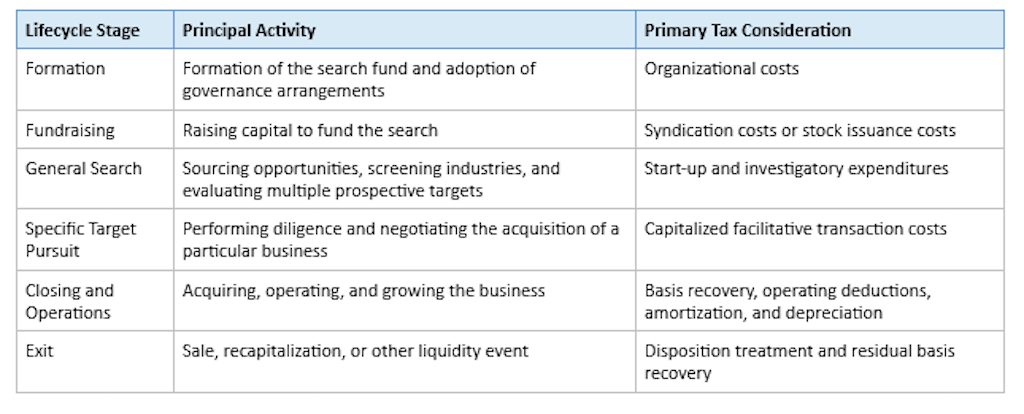
The following chart summarizes the principal stages of the search fund lifecycle and the tax considerations typically associated with each stage.
How the Tax Rules Actually Apply
Search funds are often described in simple terms. The searcher raises capital, acquires a business, and creates value through thoughtful ownership. The tax treatment of the search phase is less intuitive. Many costs that feel like ordinary business expenses, including compensation, travel, legal work, diligence, software, and other overhead, are often not immediately deductible.1 They usually fall into one of two categories. General search costs may qualify as start-up expenditures if an active business later begins.1 Target-specific deal costs often must be capitalized once the search identifies a particular target company.2, 3
There is no tax code or regime written specifically for search funds. The tax treatment instead relies on familiar rules governing start-up expenditures, entity formation costs, capital raise costs, acquisition cost capitalization, ordinary operating deductions, and exit-related selling costs.1, 3, 4, 5 What matters is not just whether an expense is business related, but when it was incurred, what it related to, who paid it, and how the entity is structured.
The Search Fund Lifecycle, in Five Cost Buckets
In practice, search fund expenses usually fall into five buckets: formation costs, capital raise costs, general search costs, target-specific acquisition costs, and post-closing operating or exit costs.1, 3, 4, 5 That framework matters because two costs incurred close together can receive very different treatment. For example, early in the search, general market research may be treated one way, while a quality-of-earnings review for a specific target may be treated another.2, 3, 8Although both take place during the search phase, they may be subject to different tax rules and therefore receive different treatment. Treatment may also vary depending on whether the deal is structured as an asset purchase, a deemed asset purchase, or a stock purchase.
The lifecycle of a traditional search fund is straightforward in business terms. It begins with formation and fundraising. It then moves into the search, which may involve sourcing opportunities, screening industries, contacting sellers, and conducting due diligence on multiple businesses. If the process narrows to a single company, more costs begin to look like acquisition costs rather than general search costs. After closing, the searcher becomes an operator and the business enters the operating phase. If the investment succeeds, the final stage is an exit through a sale, recapitalization, or other liquidity event.
The difficulty is that tax law does not always follow that intuitive story. During the search phase, the key question is whether an active trade or business has actually begun. If it has not, many costs will not be deductible as ordinary business expenses.1, 2 General investigatory costs may fall under the start-up expenditure rules and become recoverable only after the active business begins, often over time rather than immediately.1, 2 Once the search turns toward an identified specific target, more spending is treated as facilitative acquisition costs that must be capitalized.3, 6
Entity Choice and the Partnership-vs-Corporation Divide
Entity choice can sharpen that mismatch. In partnership structures, organizational costs and syndication costs are governed by different rules,5, 7 and syndication costs are far less favorable. In corporate structures, organizational expenditures and stock issuance costs are also treated differently.4, 6 The choice between a partnership and a corporation does not erase the distinction between general search costs and target-specific deal costs, but it can determine where the tax attributes land and how visible the recovery is to owners.
The analysis becomes more detailed as a deal progresses. Early industry research and review of multiple candidates may still be investigatory.2, 3, 8 Detailed accounting diligence, valuation work, acquisition documents, and other work aimed at closing a specific transaction are generally capitalized acquisition costs, even if they are incurred before a definitive agreement is signed.3, 8 Success-based fees also require care. A safe harbor may treat part of a covered fee as non-facilitative and the balance as facilitative, but that does not automatically make the non-facilitative portion currently deductible.3, 9
When Deals Fail: Two Different Recovery Problems
Failed deals can also produce results that surprise searchers. If amounts incurred in pursuing an identified target are properly characterized as target-specific facilitative costs, the failure of the transaction may raise a separate question about whether and when those capitalized amounts become recoverable. Broader investigatory expenditures present a different issue. If those amounts were incurred while the taxpayer was still deciding whether to enter a business or which business to acquire, the failure of a particular transaction does not necessarily accelerate recovery. Instead, those expenditures may remain subject to the start-up expenditure regime and may be recoverable, if at all, only after the active business begins and then only over time.1, 2, 8, 10, 11 In that setting, expenditures incurred during the same overall search can produce materially different tax consequences and recovery timing when an acquisition fails.
For example, assume a search fund incurs legal fees, accounting diligence costs, and valuation expenses in pursuing the acquisition of an identified target, but the transaction is abandoned before closing. Those target-specific costs may raise a different recovery question from amounts incurred earlier for industry screening, outreach to multiple prospective sellers, and evaluation of several candidate businesses. The failure of a particular transaction does not necessarily accelerate recovery of those earlier expenditures. If they are better viewed as search costs or start-up costs, recovery may still be delayed until the active trade or business begins and then occur only over time.1, 2, 8, 10, 11 With that distinction in mind, two categories of expenditures incurred during the same overall search may produce different tax consequences and recovery timing when the deal fails.
Who Paid Matters as Much as What Was Paid For
Another point that is easy to miss is that the result often depends on who paid the bill. The relevant taxpayer might be the searcher personally, the search fund, a management company, or a later acquisition entity. The answer can change depending on whether that taxpayer was already carrying on a business, whether the eventual deal was structured as an asset or equity acquisition, and whether the taxpayer ever began the business it was investigating.1, 2, 3, 8
This matters in practice because searchers often budget as if tax relief will roughly track cash spending. Often it does not. A search may consume significant cash over many months, yet the tax benefit may be delayed until after an acquisition closes and then recovered only gradually. That is why tracking expenses by phase, type, and payer is not just an accounting exercise. It is part of the economics of the search itself.
The core lesson is simple. The search phase is not merely a prelude to buying a business. From a tax perspective, it is a distinct planning problem. Searchers should think early about structure, document when a general investigation becomes the pursuit of a specific target, and track expenses carefully. Partnership and corporate structures can support similar business goals, but they do not always produce similar tax outcomes.
References
1. I.R.C. § 195 — Start-up expenditures.
2. Treas. Reg. § 1.195-1 — Start-up expenditure regulations.
3. Treas. Reg. § 1.263(a)-5 — Facilitative acquisition cost regulations.
4. I.R.C. § 248 — Corporate organizational expenditures.
5. I.R.C. § 709 — Partnership organizational and syndication costs.
6. Treas. Reg. § 1.248-1 — Corporate organizational expenditure regulations.
7. Treas. Reg. § 1.709-2 — Partnership syndication cost regulations.
8. Rev. Rul. 99-23, 1999-1 C.B. 998 — Investigatory costs before acquisition.
9. Rev. Proc. 2011-29, 2011-18 I.R.B. 746 — Success-based fee safe harbor.
10. Treas. Reg. § 1.165-1 — General loss deduction regulations.
11. Treas. Reg. § 1.165-2 — Abandonment loss regulations.
Disclaimer: This article is provided for general informational purposes only and does not constitute tax, legal, accounting, or other professional advice. It does not create an accountant-client relationship. Search fund structures and expense treatment are highly fact-specific and depend on the searcher's particular facts, entity structure, and transaction documents. Readers should consult qualified tax and legal advisors before making decisions based on this content. Tax laws and regulations are subject to change, and this article reflects the law as of the date of publication; Hood & Strong LLP assumes no obligation to update this content for subsequent developments.


